
AI for Midsize Businesses in 2026
Walk through the offices of a typical midsize business and you’ll see a familiar scene: busy teams juggling a patchwork of digital tools. Some departments test AI features tucked inside their favorite software, while others stay cautious, unsure whether the technology will ever move beyond isolated pilots and proof-of-concept demos. The buzz around artificial intelligence is impossible to ignore, but for most midsize organizations, real change still feels a few steps away.
"The question for every leader isn’t whether to use AI, but how to do so in a way that builds resilience, unlocks value, and sets the stage for sustainable growth"
Yet there’s a growing sense of inevitability. The conversation is shifting from “Should we explore AI?” to “How soon will it become core to how we operate?” As business leaders weigh how to approach, 2026 stands out: not as a distant milestone, but as a moment when AI shifts from optional experiment to operational backbone. The question isn’t whether AI will shape how midsize businesses compete, but how deeply those changes will define everyday work.
That shift starts with understanding what AI actually means for midsize businesses in the years ahead.
What AI for Midsize Businesses Will Really Mean in 2026
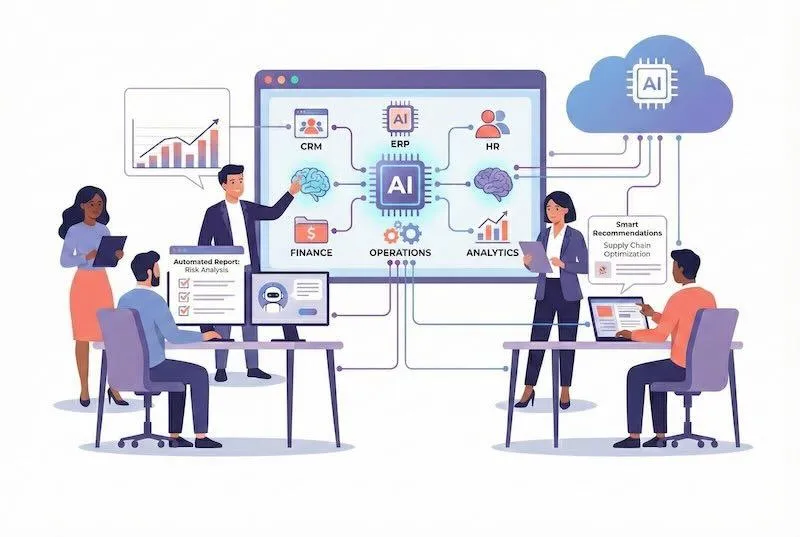
AI for midsize businesses will cover a range of capabilities woven into familiar business tools. Automation will eliminate repetitive tasks, analytics will surface trends and anomalies, digital copilots will guide decision-making, and smart recommendations will support teams in real time. Rather than being siloed as standalone AI projects, these features will appear as natural extensions of customer relationship management (CRM) systems, enterprise resource planning (ERP) platforms, HR software, accounting programs, and collaboration suites. A regional manufacturer might find demand forecasting built right into its inventory dashboard, while a services firm sees client insights automatically flagged in its CRM.
"For midsize businesses, the defining feature of AI in 2026 will be its seamless integration into everyday work, not its novelty, but its usefulness."
The sophistication of AI by 2026 will be practical. The vision isn’t fully autonomous businesses operating without people, but augmented teams: employees supported by intelligent systems that automate routine work, flag exceptions, and provide data-driven guidance. Think of a finance manager who reviews auto-generated reports with key risks highlighted, or a sales team using AI-generated customer profiles to tailor outreach. Human judgment stays front and center, with AI acting as a partner that streamlines workflows and improves decision quality. For midsize businesses, the defining feature of AI in 2026 will be its seamless integration into everyday work, not its novelty, but its usefulness.
Why 2026 Is a Turning Point for AI Adoption in Midsize Organizations
Several converging trends are setting the stage for a sharp increase in AI adoption among midsize businesses over the next two years. First, technology maturity is rewriting what’s possible and what’s affordable. Cloud platforms now give midsize firms access to advanced AI capabilities, embedding intelligence into the software many businesses already rely on. As vendors build AI-driven features directly into their products, the barriers traditionally faced by midsize organizations, including high costs, complex deployments, and scarce technical expertise, are shrinking. Analyst firms such as Gartner and IDC forecast that by 2026, most new business software for midsize firms will ship with embedded AI as a standard feature, not an add-on.
Competitive pressure is building as well. Early adopters are already using AI to improve efficiency, enhance customer experience, and make faster, more informed decisions. A mid-market distributor, for instance, might use predictive analytics to minimize stockouts and optimize inventory. In the professional services sector, some firms are streamlining proposal creation and client research with AI assistance, shortening cycles and freeing up staff for higher-value work. The risk for organizations that lag behind is clear: as the adoption gap widens, those clinging to manual processes will be outpaced on speed, accuracy, and customer responsiveness.
At the same time, the regulatory landscape is taking shape to support safer AI adoption. Evolving data privacy laws and emerging AI governance frameworks are providing clearer guardrails for responsible use, topics that have caused many midsize leaders to hesitate. Industry groups and government bodies are collaborating to establish best practices around transparency, accountability, and data protection in AI applications. For midsize organizations, 2026 represents the convergence of accessible technology, competitive necessity, and regulatory clarity: a moment when AI moves from experimental to essential, and inaction becomes the riskier stance.
High-Impact AI Use Cases Midsize Businesses Should Expect by 2026
By 2026, AI will move beyond isolated pilots to become an integral part of how midsize businesses operate across functions. In the front office, AI-driven chatbots and virtual assistants will handle routine customer support questions, escalating only the complex cases to human agents. Sales teams will benefit from AI-powered lead scoring, automated follow-ups, and deeper insights into customer preferences, enabling more personalized outreach without adding headcount. Marketing departments will use AI to continuously optimize campaigns, segment audiences, and generate content tailored to specific customer personas, while human strategists oversee the overall direction.
"The risk for organizations that lag behind is clear: as the adoption gap widens, those clinging to manual processes will be outpaced on speed, accuracy, and customer responsiveness"
On the operational side, back-office functions will see AI embedded directly within core systems. Inventory forecasting will become more precise by automatically analyzing sales patterns, seasonality, and external data, helping retailers and distributors reduce excess stock and missed sales. Automated document processing will extract, validate, and route information from invoices, contracts, and onboarding paperwork, cutting manual entry and error rates. Risk and compliance monitoring will improve, with AI systems flagging anomalies and potential issues for human review, easing the burden on already stretched compliance teams.
A particularly important trend will be the rise of cross-functional copilot assistants tailored for finance, HR, operations, and IT. These AI copilots will help employees surface relevant data, generate reports, and suggest next steps, reducing time spent hunting for information or performing repetitive analysis. An HR manager could use an AI assistant to quickly identify skills gaps across teams or flag potential retention risks, while a finance analyst relies on AI to reconcile transactions and highlight outliers. In each case, human oversight is essential: AI augments roles by handling volume and complexity, allowing people to focus on judgment, relationship building, and strategic thinking. The outcome isn’t the elimination of jobs, but the elevation of work.
How Midsize Leaders Can Prepare for AI in 2026 Without Overbuilding
With so much promise on the horizon, it’s tempting to rush into large-scale AI initiatives. Yet businesses gain more by laying a strong foundation and moving incrementally. The first step is getting data in order: cleaning up customer records, consolidating key systems, and making sure information flows smoothly between departments. Basic analytics literacy across teams is equally important, so employees are comfortable interpreting insights that AI will soon deliver. Establishing simple principles or guardrails for AI experimentation, such as how data will be used, who has oversight, and how outcomes will be evaluated, builds a culture of safety and trust.
Low-risk, high-learning pilots are a smart way to build momentum. This could mean enabling AI features in existing tools, such as activating automated scheduling in HR software or using generative text suggestions for internal communications. You might sandbox new AI-powered capabilities for tasks like summarizing meeting notes or streamlining expense approvals within a single department first. The goal is to generate quick wins, surface issues early, and learn before scaling up. Rather than betting big on custom-built solutions, start with what’s available and watch how teams adapt.
Internal readiness is just as critical as technology. Upskilling staff with focused AI training, clarifying who leads and governs AI initiatives, and setting realistic success metrics for 2026 will help avoid burnout and disappointment. For example, track the impact of pilots on turnaround times, accuracy rates, or employee satisfaction, not just cost savings. Build a feedback loop where lessons learned shape future investments, so the organization stays flexible enough to benefit as AI capabilities mature. By thinking in terms of steady evolution rather than sweeping overhaul, midsize leaders can move confidently toward an AI-enabled future: one step, one insight, and one success at a time.
"The goal is to generate quick wins, surface issues early, and learn before scaling up."
The next few years will redefine what it means to be a modern business. AI is set to become less of a shiny add-on and more of a quiet engine powering core processes, decisions, and customer experiences. The organizations that succeed will approach AI with a clear view, investing in practical foundations, staying attuned to emerging best practices, and making space for people and machines to work side by side. The question for every leader isn’t whether to use AI, but how to do so in a way that builds resilience, unlocks value, and sets the stage for sustainable growth. Now’s the time to assess where you stand and chart a thoughtful course toward the opportunities and responsibilities of the AI era.
